

Novel Endothelial Subtype Uncovered in Human Coronary Atherosclerosis

Cloud-Clone Enables Clinical Validation of Circulating OGN Biomarker in Nature Cell Biology-Published Research
HUSTON, TX, UNITED STATES, September 28, 2026 /EINPresswire.com/ -- Cloud-Clone Enables Clinical Validation of Circulating OGN Biomarker in Nature Cell Biology-Published Research
Published in Nature Cell Biology, a research team from Fuwai Hospital leveraged single-cell RNA sequencing to profile human coronary artery specimens across distinct pathological stages. The work identifies a pathogenic endothelial subset EC5 SLCO4A1+ that fuels atherosclerosis progression, unveils PRDM15-driven endothelial reprogramming and pro-inflammatory cell-to-cell crosstalk, and validates circulating OGN as a non-invasive serum biomarker for atherosclerotic burden. Cloud-Clone’s ELISA kit supported large-scale quantitative protein measurement in patient serum cohorts to complete this full-loop translational study.
Research Background
Coronary artery disease ranks among the leading causes of mortality worldwide, with coronary atherosclerosis serving as the pathological origin of severe cardiovascular events including myocardial infarction and sudden cardiac death. Atherosclerosis is not merely lipid deposition but a chronic vascular inflammatory disorder driven by multi-cellular interactions over progressive pathological phases ranging from early fatty streaks to advanced thin-fibrous-cap vulnerable plaques. Dysfunction of vascular endothelial cells acts as the initiating trigger for the entire pathological cascade.
Most atherosclerosis mechanistic investigations rely on genetically modified mouse models such as ApoE/ and Ldlr-/-. While these animal models have advanced the field substantially, notable interspecies discrepancies exist between mice and humans regarding coronary vascular anatomy, cellular phenotypes and lipid metabolism. Observations obtained from animal experiments often cannot be fully recapitulated in human diseased tissues. Constrained by limited access to human coronary specimens, high-quality staged single-cell atlases of human coronary arteries have long been scarce, hindering the understanding of human vascular cell pathological states.
Furthermore, current clinical coronary assessment modalities carry inherent limitations. Coronary CTA and angiography visualize luminal stenosis yet involve radiation exposure and high costs, making them unsuitable for large-scale general-population screening. Non-invasive, accessible peripheral blood biomarkers capable of reflecting total coronary atherosclerotic burden remain an unmet clinical need. Robust serum biomarkers would deliver substantial clinical value for early-risk warning and longitudinal disease monitoring for high-risk populations.
Against these two major bottlenecks, investigators from the State Key Laboratory of Cardiovascular Disease at Fuwai Hospital conducted this study. They collected human coronary artery tissues representing successive disease stages, deployed single-cell RNA sequencing to dissect cellular heterogeneity, mapped key transcriptional regulatory circuits and cell-communication networks, and validated secreted-protein biomarker candidates using clinical serum cohorts. This work establishes a complete translational pipeline bridging basic cellular mechanistic discovery to clinical application.
Key Research Findings
A research team from Fuwai Hospital published the paper Single-cell transcriptomics uncovers endothelial progenitor-like remodelling driving human coronary atherosclerosis progression in Nature Cell Biology in July 2026, aiming to decipher cell-level alterations during human coronary atherosclerosis advancement.
Figure 1 Caption: Article page of the Nature Cell Biology publication
2.1 Construction of Staged Single-Cell Atlas of Human Coronary Atherosclerosis
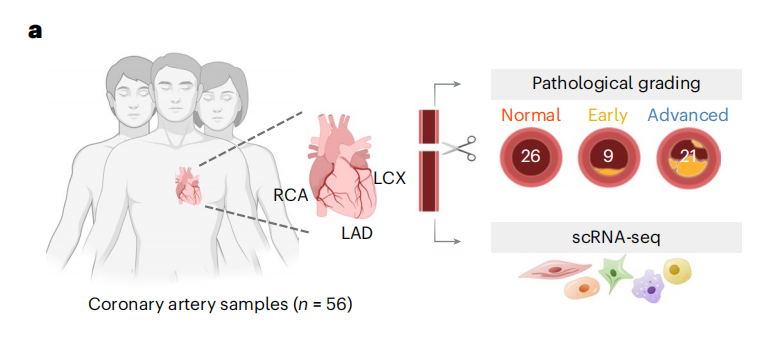
Fifty-six human coronary artery specimens were harvested from 19 heart-transplant donors and pathologically stratified into normal, early-stage atherosclerosis and advanced-stage atherosclerosis groups. After sample dissociation, library construction and single-cell sequencing, 27 941 high-quality cells were captured. Nine major cell classes were annotated and further subdivided into 37 vascular and immune cell subsets covering principal plaque-microenvironment constituents: endothelial cells, vascular smooth muscle cells, fibroblasts, macrophages, T-lymphocytes, B-lymphocytes and mast cells.
Figure 2 Caption: Fifty-six human coronary artery segments across three atherosclerotic pathological grades were collected for pathological grading and single-cell RNA-seq (scRNA-seq). Figure adapted from Nature Cell Biology.
Core innovation: identification of novel endothelial subtype EC5 SLCO4A1+ Researchers characterised a distinctive endothelial subpopulation EC5 SLCO4A1+, marked by high SLCO4A1 expression and transcriptional signatures of endothelial progenitor-like cells. The proportional abundance of EC5 SLCO4A1+ rises continuously as atherosclerosis advances from early to late phases. This subset down-regulates canonical endothelial-barrier genes, acquires enhanced migratory and angiogenic capacities while disrupting vascular barrier integrity. These changes facilitate lipid infiltration and immune-cell recruitment into the intima, designating EC5 SLCO4A1+ as a pivotal cellular driver of human coronary plaque progression.
2.2 PRDM15 Acts as a Master Transcription Factor Governing Pathological Endothelial Reprogramming
Following the identification of EC5 SLCO4A1+, the group explored molecular triggers converting quiescent mature endothelium into this pathological state. Integrating transcription-factor prediction, multi-omics screening, CUT&Tag sequencing and functional assays on primary endothelial cells, PRDM15 was pinpointed as the central regulator. CUT&Tag data confirmed that PRDM15 directly binds genomic loci to activate SLCO4A1 and other signature target genes of the EC5 programme, thereby instructing mature endothelial cells to undergo pathological reprogramming towards the EC5 SLCO4A1+ phenotype.
Endothelium-specific Prdm15 overexpression and knockout mouse models on the ApoE-/- background were generated for in-vivo functional validation: ✅ Endothelial-specific Prdm15 overexpression: enlarged aortic and coronary plaque size, expanded necrotic cores, massive intra-plaque macrophage infiltration and reduced plaque stability. ✅ Endothelial-specific Prdm15 deletion: ameliorated atherosclerotic lesions, diminished plaque volume, thicker fibrous caps, improved plaque stability and fewer EC5-like pathological endothelial cells.
Combined in-vitro and in-vivo evidence validates PRDM15 as the key transcriptional mediator of endothelial progenitor-like pathological reprogramming and a promising candidate therapeutic target for coronary artery disease.
2.3 Bidirectional Pro-Inflammatory Circuit between EC5 Cells and Macrophages Amplifies Plaque-Local Inflammation
Cells within atherosclerotic plaques communicate persistently via ligand-receptor interactions. Cell-communication analysis was performed to characterise crosstalk between EC5 SLCO4A1+ and surrounding immune populations. EC5 SLCO4A1+ cells secrete high levels of chemokine CXCL9, while pro-inflammatory plaque macrophage subset MP2 act abundantly expresses CCL3. This ligand-receptor pair forms a bidirectional pro-inflammatory feedback loop: EC5 recruits additional pro-inflammatory macrophages into plaques, and infiltrating macrophages in turn release inflammatory mediators that further push endothelial cells toward pathological phenotypes. This self-reinforcing cycle amplifies local chronic inflammation and accelerates plaque deterioration, explaining how endothelial reprogramming modulates immune microenvironments to aggravate atherosclerosis.
2.4 Clinical-Serum-Cohort Validation: OGN Represents a Candidate Non-Invasive Biomarker for Coronary Atherosclerosis
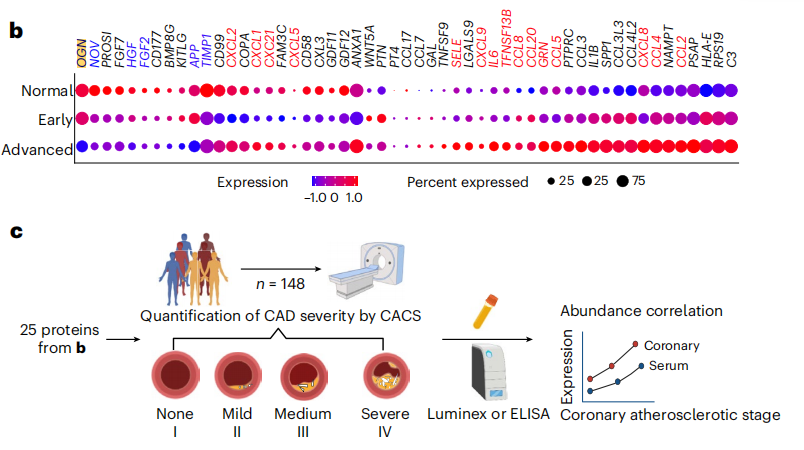
Twenty-five significantly altered secreted ligand candidates were filtered from single-cell ligand-receptor profiling. To assess their potential as circulating biomarkers, a clinical validation workflow was implemented enrolling 148 patients undergoing coronary CTA examinations. Peripheral serum samples were subjected to protein quantification, and readouts were correlated against clinical indices such as coronary-artery-calcification scores.
Serum osteoglycin (OGN) concentration showed significant positive correlation with coronary-artery-calcification score, a well-established clinical metric for global coronary atherosclerotic burden. This indicates circulating OGN protein levels can indirectly reflect atherosclerotic severity. If corroborated in larger cohorts, OGN may evolve into a practical serum-based assay alternative to radiation-associated, high-cost coronary CTA, supporting high-risk-population screening, disease-severity evaluation and longitudinal patient monitoring and offering new translational opportunities.
Figure 3 Caption: Screening workflow for secreted biomarker candidates. Twenty-five candidate proteins derived from single-cell analysis were tested in 148 clinical patient serum samples, with readouts correlated to coronary atherosclerotic severity. Figure adapted from Nature Cell Biology.
Cloud-Clone Supports Quantitative OGN Detection for Serum-Sample Cohorts
The clinical-cohort validation stage required robust quantification of OGN protein across hundreds of human serum specimens. For batch clinical samples, detection platforms must balance sensitivity, specificity, throughput and cost-effectiveness. ELISA fits these requirements well for secretory-protein biomarker cohort validation because it avoids reliance on sophisticated large-scale instrumentation, features established workflows and flexible throughput compatible with large-population-sample screening.
As a secreted matrix protein, OGN can be assayed in serum, plasma, cell-culture supernatants and tissue homogenates. Cloud-Clone has built a comprehensive reagent portfolio targeting OGN to suit diverse experimental workflows including atherosclerosis clinical-sample validation, in-vivo animal-model studies and in-vitro mechanistic cell experiments.
The referenced assay kit in this publication: USEC688Hu Human Osteoglycin (OGN) ELISA Kit.
Research Insights and Future Project Directions
This Nature Cell Biology study delivers multiple innovative research angles valuable for basic science and translational medicine. Potential research avenues include:
1.Endothelial cell plasticity and vascular pathological reprogramming: The discovery of EC5 SLCO4A1+ updates understanding of human coronary endothelial dysfunction. Investigators may explore upstream signalling and epigenetic modulation governing endothelial reprogramming centred on the PRDM15/SLCO4A1 axis to advance research into endothelial injury and vascular remodelling.
2.Plaque-microenvironment cell-cell interactions and inflammatory mechanisms: The CXCL9-CCL3 bidirectional pro-inflammatory axis between EC5 endothelial cells and pro-inflammatory macrophages can be further explored for chronic plaque-inflammation research and drug-screening campaigns seeking compounds interrupting this inflammatory loop, informing anti-atherosclerotic therapeutic development.
3.Clinical translation of cardiovascular serum biomarkers: Larger clinical cohorts can evaluate associations between circulating OGN and major adverse cardiovascular events as well as comorbidities including diabetes, hyperlipidaemia and chronic kidney disease. Multi-marker combinatory diagnostic panels may also be constructed to boost diagnostic performance.
4.Discovery and validation of novel therapeutic targets: Given the in-vivo regulatory function of PRDM15 over plaque progression, intervention studies targeting PRDM15 can be executed to assess plaque-stabilising effects and generate pre-clinical evidence for coronary-disease-directed therapies.
5.Multi-omics integrative analysis: Using the publicly released human-coronary-artery single-cell dataset from this work, researchers may mine additional key genes and secreted-protein candidates for vascular-disease targets and biomarkers.
By analysing precious human coronary-artery tissues and single-cell transcriptomic profiling across pathological grades, the Fuwai Hospital team identifies the plaque-driving pathogenic endothelial subset EC5 SLCO4A1+, characterises PRDM15-governed endothelial progenitor-like reprogramming, delineates pro-inflammatory endothelial-macrophage communication, and validates circulating OGN as a candidate non-invasive marker estimating coronary atherosclerotic burden. The investigation realises a complete research workflow spanning basic discovery, mechanistic verification to clinical translation.
For cardiovascular investigators, PRDM15, SLCO4A1 and the CXCL9/CCL3 axis provide fresh directions for atherosclerosis mechanistic research and therapeutic-target exploration. Meanwhile, Cloud-Clone’s OGN ELISA kit enables high-throughput protein quantification across clinical and animal specimens to support biomarker validation and cohort-based projects, facilitating more translational cardiovascular research outputs worldwide.
Reference Yao, F., Li, F., Gai, S. et al. Single-cell transcriptomics uncovers endothelial progenitor-like remodelling driving human coronary atherosclerosis progression. Nat Cell Biol (2026). https://doi.org/10.1038/s41556-026-02022-7
About Cloud-Clone Corp.
Cloud-Clone Corp. is dedicated to the development and production of high-quality immunoassay reagents and detection solutions. With a focus on antibody engineering, multiplex assay development, and cross-platform compatibility, the company provides research tools designed to support precision medicine and advanced biomedical investigation globally. Our core products and services include the research and development of proteins, antibodies, ELISA kits, primary cells, and multiplex cytokine assay kits, as well as professional CRO services to fully meet the diverse needs of biomedical research and related fields.
For more information about Cloud-Clone Corp, visit www.cloud-clone.com.
CLOUD-CLONE CORP.(CCC)
Tel: 001-832-538-0970, 0086-27-8425-9552
Email: mail@cloud-clone.com, sales@cloud-clone.us
Visit us on social media:
LinkedIn: https://www.linkedin.com/company/cloud-clone-corp/
Instagram: https://www.instagram.com/cloudclonecorp2023/
TickTok: https://www.tiktok.com/@cloudclonecorp2026
SuKi Duan
CLOUD-CLONE CORP.WUHAN
email us here
Visit us on social media:
LinkedIn
Instagram
TikTok
X
Legal Disclaimer:
EIN Presswire provides this news content "as is" without warranty of any kind. We do not accept any responsibility or liability for the accuracy, content, images, videos, licenses, completeness, legality, or reliability of the information contained in this article. If you have any complaints or copyright issues related to this article, kindly contact the author above.
